ATEX
SOLAS II-2, 4 Probability of ignition
1.5 ignition sources shall be separated from combustible materials
flammable liquids.
flammable liquids.
Some work environments can hide hazards that aren’t immediately obvious to those exposed. Gases, vapours, and dust can ignite into explosions that cause fires. Facilities like hydrocarbon processing, transport, and storage plants, as well as distilleries and mills, pose potential risks that need to be managed by preventing ignition sources. Both fixed and mobile equipment in hazardous zones must be designed so they don’t let a risk escalate. Equipment and systems in these areas are regulated under the European ATEX standards.
ATEX, short for Atmospheres Explosible, includes Directive 2014/34/EU (dated February 26, 2014), which applies to equipment manufacturers, and Directive 99/92/EC, aimed at protecting worker safety. These rules require the classification of explosive sources, zoning, and prevention measures, Directive 94/9/EC (transitional expired). They ensure safety in environments where there’s a risk of explosion from gases, vapours, or dust.
DSome definitions
- Explosive atmosphere" is given in accordance with Directive 99/92/EC;
- For the purposes of this Directive, "explosive atmosphere" means a mixture with air, under atmospheric conditions, of flammable substances in the form of gases, vapours, mists or dusts in which, after ignition has occurred, combustion spreads to the entire unburned mixture;
- Intrinsics safety & non-incentive: are equipment and wiring methods, where apparatus is designed with low power levels and low stored energy, so that an arc produced during normal functioning of the equipment or as the result of equipment failure has insufficient energy to initiate ignition of the explosive mixture.
Prevention of and protection against explosions
To prevent explosions, apply suitable technical or organizational measures prioritizing: stopping explosive atmospheres from forming, avoiding ignition if prevention isn't possible, and minimizing explosion effects to protect worker health and safety. Supplement with actions to block explosion spread when needed, and review all measures regularly, especially after major changes.
Assessment
Assessing risks from explosive atmospheres requires considering their likelihood, duration, potential ignition sources (such as electrostatic discharges), installations, substances, processes, and interactions. Evaluation should include the scale of possible effects and areas connected to locations where explosive atmospheres may arise.
Places where explosive atmospheres may occur are classified in xones
In each zone shall ensure that the minimum requirements are applied. Where necessary, places where explosive atmospheres may occur in such quantities as to endanger the health and safety of workers shall be marked with signs at their points of.
ATEX Marking dimensions
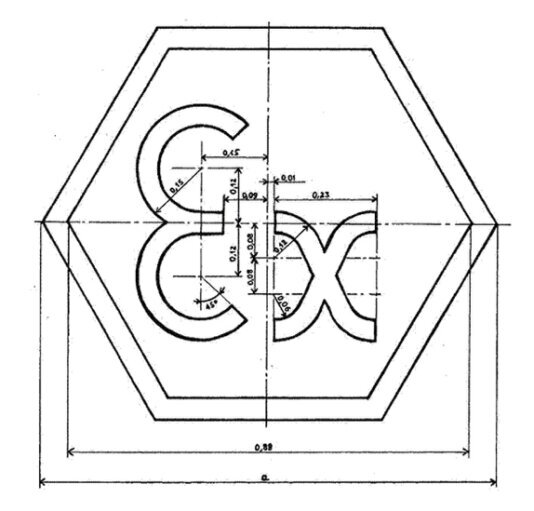
ATEX Marking
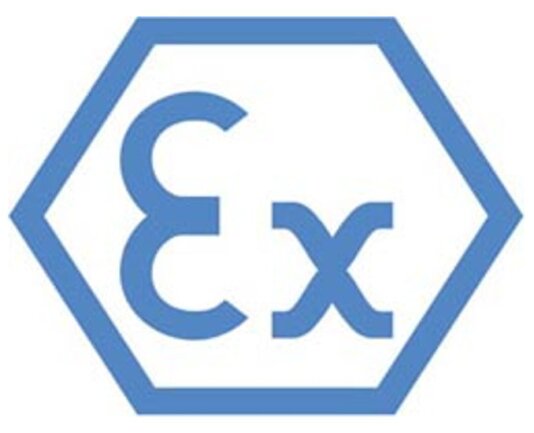
- Directive 99/92/EC, also known as ATEX 137 or the ATEX Workplace Directive, sets out the basic requirements for improving the health and safety of workers who might be exposed to explosive atmospheres.
- Directive 94/9/EC, also known as 'ATEX 95' or the ATEX Equipment Directive. Dictates the approximation of the laws of Members States concerning equipment and protective systems intended for use in potentially explosive atmospheres. This Directive was replaced by
- Directive 2014/34/EU on 20 April 2016. This change brought in new rules under the European regulatory framework (TFEU) and the “New Regulatory Framework” (NFR) for products used in potentially explosive environments.
Directive 2014/34/EU
Directive 2014/34/EU, also known as the ATEX "Products" Directive, deals with the sale and use of equipment, protective systems, and their components designed for potentially explosive atmospheres, whether caused by gas, vapor, mist, or dust, within the EU/EEA. It applies to both electrical and non-electrical gear used in industries such as mining, oil and gas, and chemical processing.
Equipment and protective systems are designed for use in potentially explosive environments. Safety and controlling devices, while used outside such areas, play a vital role in ensuring the safe operation of equipment within them. Components are the essential parts that support the safe functioning of both equipment and protective systems.
ATEX Directives history and scope
B The ATEX Directive doesn’t just consider explosive concentrations of gas, vapor, or mist in the air—it also covers potentially explosive dust in the air. It looks at both electrical and mechanical sources of ignition. Any control equipment used to keep operations safe in hazardous areas is also included under Directive 94/9. At the same time, Directive 99/92/EC comes into effect, setting minimum requirements for improving the safety and health of workers who might be at risk from explosive atmospheres.
A hazardous location is an area where flammable gases, vapoUrs, or dusts are present. Electrical equipment used in these areas is specially designed and tested to prevent explosions caused by arcing contacts or high surface temperatures.
Zones are risky areas defined by how often and for how long an explosive atmosphere might exist. Their classification, along with their size and location, depends on the likelihood of such an atmosphere forming and how long it would probably stick around if it did.
Hazardous areas are divided into zones based on how often and for how long an explosive atmosphere is present.
Gas, vapour zones
- Zone 0 is a place in which an explosive atmosphere consisting of a mixture with air of flammable substances in the form of gas, vapour or mist is present continuously or for long periods or frequently.
- Zone 1 is a place in which an explosive atmosphere consisting of a mixture with air or flammable substances in the form of gas, vapour or mist is likely to occur in normal operation occasionally.
- Zone 2 is a place in which an explosive atmosphere consisting of a mixture with air of flammable substances in the form of gas, vapour or mist is not likely to occur in normal operation but, if it does occur, will persist for a short period only.
Dust zones
- Zone 20 is a place in which an explosive atmosphere in the form of a cloud of combustable dust in air is present continously, or for long periods or frequently.
- Zone 21 is a place in which an explosive atmosphere in the form of a cloud of combustible dust in air is likely to occur in normal operation occasionally.
- Zone 22 is a place in which an explosive atmosphere in the form of a cloud of combustible dust in air is not likely to occur in normal operation but, if it does occur, will persist for a short period only.
Zoned areas
The subscripts 0, 1 and 2 describe the probability of a flammable material being released to atmosphere in explosive concentrations. - the time.
Dust zone
NOTE The zone classified for dust are named: 20, 21,22 (es. Carbon mines)The ATEX Directive 2014/34/EU (ATEX 114) concerns equipment manufacturers. The Product Directive (2014/34/EU - formerly 94/9/EC): Applies to manufacturers of machinery, electrical, and non-electrical components intended for use in hazardous areas. It requires the specific CE marking (Ex marking).
(1994)
Equipment Categories
Group I equipment is intended for use in mining applications.
Two categories: M1 and M2.
M1: equipment that must continue to operate when a potentially explosive atmosphere is present.
M2: equipment that does not operate when a potentially explosive atmosphere is present.
Group II is intended for all other situations, divided into categories 1,2 and 3.
Category 1 equipment is intended for use in Zone 0 (& 20) situations.
Category 2 (and 1) equipment is intended for use in Zone 1 (& 21) situations.
Category 3 (and 1 or 2) equipment is intended for use in Zone 2 (& 22) situations.
Directive 2014/34/EU, known as the ATEX "Products" Directive, deals with selling and putting into use equipment, protective systems, and their parts meant for potentially explosive environments caused by gas, vapor, mist, or dust within the EU/EEA. It covers both electrical and non-electrical gear used in industries like mining, oil and gas, and chemical processing.
Equipment certificates
It is mandatory for manufacturers to obtain an EC Type Examination Certificate from a notified body for electrical equipment in Categories M1, M2, 1 and 2 or diesel engine protection systems in Category 2.
In all other cases manufacturers are free to certify their own equipment which is similar to the situation that has always existed under the old Explosive Atmosphere Directive.
The Directive 2014/34/EU
of the European Parliament and of the Council of 26th February 2014, relating to equipment and protective systems intended for use in potentially explosive atmospheres.
The Directive covers these 'products': equipment and protective systems for potentially explosive atmospheres, safety, controlling, and regulating devices used outside but necessary for safe functioning regarding explosion risks, and components for equipment and systems.
Doesn't apply to:
Medical devices; equipment and systems where explosion risk is only from explosive or unstable chemicals; equipment for home use; personal protective gear covered by another directive; seagoing vessels, offshore units, and their onboard equipment; vehicles.
Definitions:
'Protective systems' are devices, separate from equipment components, designed to stop explosions early or limit their impact, and are sold as standalone systems.- 'Explosive atmosphere' refers to a mix of air and flammable gases, vapours, mists, or dusts that can ignite and cause combustion throughout the mix.
- "Potentially explosive atmosphere" means an environment that might become explosive because of local and operational conditions.
- (6) ‘equipment-group I’ means equipment intended for use in underground parts of mines, and in those parts of surface installations of such mines, liable to be endangered by firedamp and/or combustible dust, comprising equipment categories M 1 and M 2 as set out in Annex I;
- (7) ‘equipment-group II’ means equipment intended for use in other places liable to be endangered by explosive atmospheres, comprising equipment categories 1, 2 and 3 as set out in Annex I;
REGULATION (EC) No 765/2008 OF THE EUROPEAN PARLIAMENT AND OF THE COUNCIL of 9 July 2008
setting out the requirements for accreditation and market surveillance relating to the marketing of products and repealing Regulation (EEC).ANNEX II; CE marking.
If the CE marking is reduced or enlarged, the proportions given in the graduated drawing in paragraph 1 shall be respected.
Where specific legislation does not impose specific dimensions, the CE marking shall be at least 5 mm high.
CE Marking The CE marking shall consist of the initials ‘CE’ taking the following form:

Regulation (EC) No 765/2008 was adopted to create a uniform legal basis for accreditation across the EU, eliminate technical barriers to trade, ensure public trust in conformity assessment, and strengthen the functioning of the Single Market.13 nov 2025\
Equipment-group I:
Equipment category M 1 comprises equipment designed and, ... ensuring a very high level of protection.
Equipment in this category is intended for use in underground parts of mines as well as those parts of surface installations of such mines endangered by firedamp and/or combustible dust.
Equipment in this category is required to remain functional, even in the event of rare incidents relating to equipment, with an explosive atmosphere present.
Equipment category M 2 is intended to operate in the same environments as M1 equipment, but in the event of an accident they will be deactivated in the event of an explosive atmosphere
Equipment-group II
Category 1 equipment includes devices built
to operate reliably while providing a very high level of protection. This type
of equipment is designed for use in areas where explosive atmospheres from air
mixed with gases, vapours, mists, or air and dust combinations are present
continuously, for extended periods, or occur frequently.
In the event of rare incidents relating to
equipment is characterised by means of protection such that: either, in the
event of failure of one means of protection, at least an independent second
means provides the requisite level of protection or the requisite level of
protection is assured in the event of two faults occurring independently of
each other.
Category 2 equipment is designed to operate
in the same environments as Category 1 equipment, providing a high level of
protection, where occasional failures are likely to occur. The means of
protection ensure the requisite level of protection, even in the event of
frequently occurring disturbances or equipment faults which normally have to be
taken into account.
Category 3 equipment is designed to operate
in the same environments as Category 1, equipment, providing a normal level of
protection, are unlikely to occur or, if they do occur, are likely to do so
only infrequently and for a short period only. This category equipment ensures
the requisite level of protection during normal operation.
ESSENTIAL HEALTH AND SAFETY REQUIREMENTS RELATING TO THE DESIGN AND CONSTRUCTION OF EQUIPMENT AND PROTECTIVE SYSTEMS
Equipment and protective systems intended for use in potentially explosive atmospheres must prioritize integrated explosion safety. Manufacturers should aim to prevent the formation of explosive atmospheres and the ignition of such atmospheres, considering all potential sources of ignition. If an explosion occurs, measures should be in place to immediately stop it or limit its impact to ensure the safety of people, animals, and property.
Equipment and protective systems should be designed and constructed to effectively handle both current and anticipated conditions in their surrounding environment.
Marking
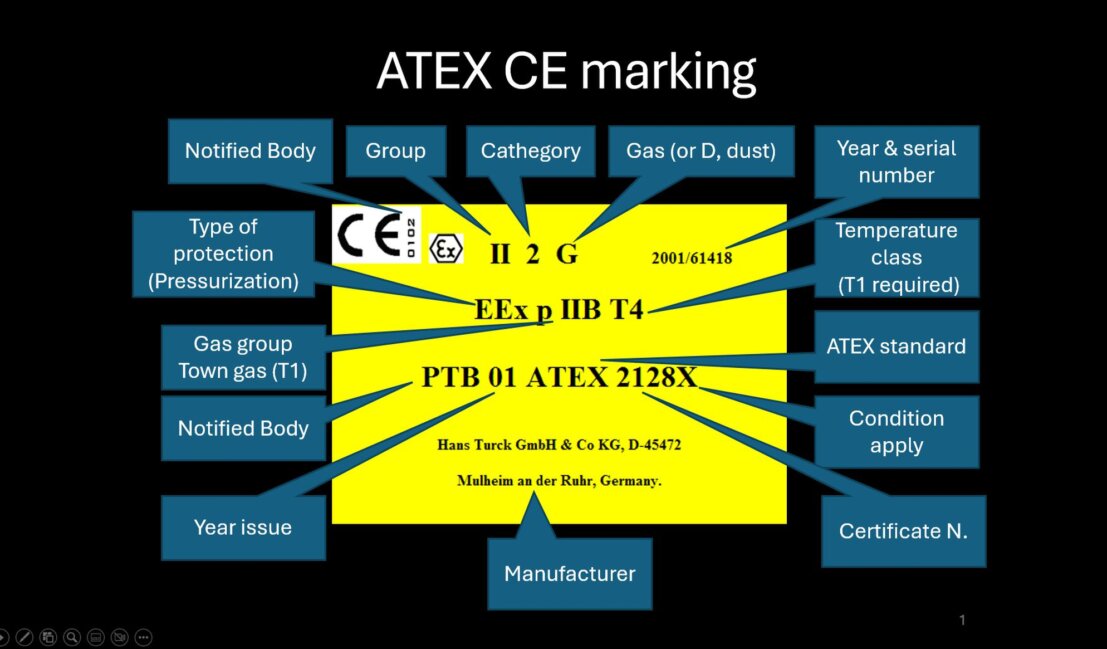
The equipment and protective systems must be so marked: name, registered trade name or registered trade mark, and address of the manufacturer; CE marking; designation of series or type; batch or serial number, if any; year of construction; the specific marking of explosion protection; equipment-group and category; for equipment-group II, the letter ‘G’ (concerning explosive atmospheres caused by gases, vapours or mists), and/or the letter ‘D’ (concerning explosive atmospheres caused by dust), ad all information essential to their safe use.CE Marking, Example of CE mark label, details are evidenced
Heat producing elements
motor winding, electrical heaters and lighting fixtures are designed to limit their maximum temperature below the autoignition temperature of the material involved.
Both external and internal temperatures are taken into consideration.
Arc-producing elements
Can be isolated from the surrounding
atmosphere by: encapsulation, immersion in oil, sand, etc.
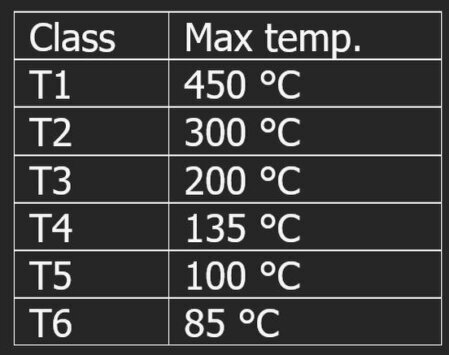
Temperature Classes
Gases are classified by ignition
temperature
The list shows the maximum surface
temperatures for each class.
Tipe of protection
- Intrinsic Safety (EExi): The electrical energy is kept at too low a level to ignite an explosive atmosphere even under fault conditions.
- Flameproof (EExd): The enclosure is designed and installed such that if a flammable mixture enters the enclosure and is ignited, the enclosure will withstand the internal explosion without transmitting the ignition to an explosive atmosphere outside the enclosure.
- Pressurisation (EExp): The enclosure is maintained at a pressure above the surrounding atmosphere using a protective gas thereby excluding the explosive atmosphere.
- Increased Safety (EExe): Additional measures are taken to reduce the risk of excessive temperatures or other sources of ignition on apparatus which does not produce arcs or sparks in normal servicej.
- Encapsulation (EExm): Contact with the explosive atmosphere is prevented by encapsulating the equipment in a solid epoxy resin.
- Oil Immersion (EExo): Contact with the explosive atmosphere is prevented by immersing the equipment in an oil bath.
- Powder Filling (EExq): Contact with the explosive atmosphere is prevented by encasing the equipment in an inert powder.
- Non-Incendive (EExn): Enclosure are designed to minimise the risk of mechanical damage and ingress of outside atmosphere.
CE Marking for electrical equipment
ATEX CE Marking Most recent release
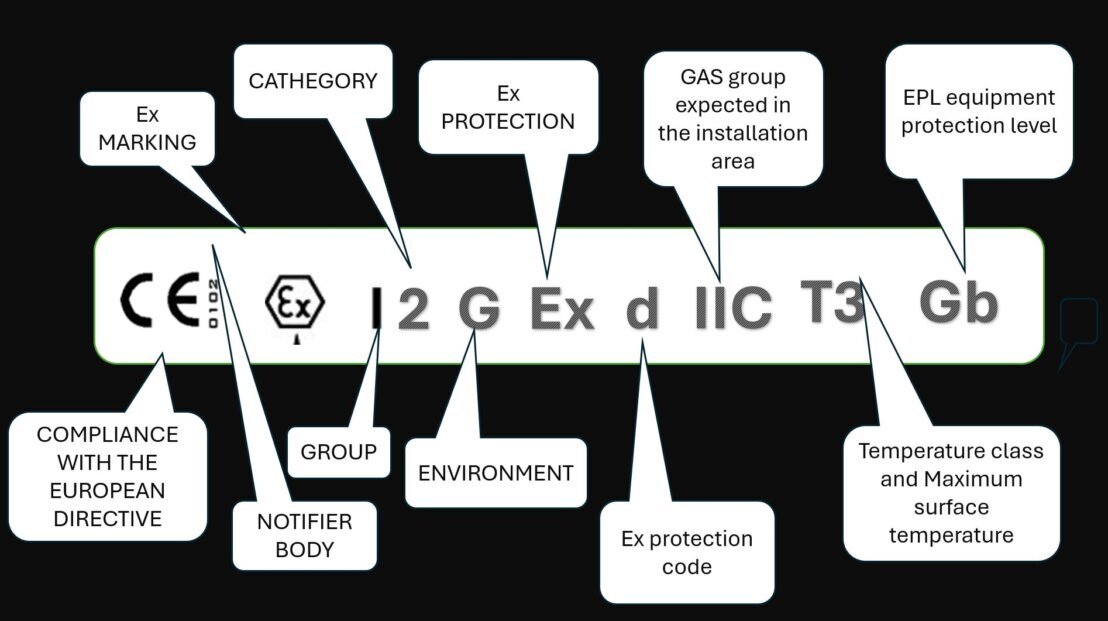
- CE marking;
- Number of the Notified Body responsible for surveillance (four digits);
- Symbol of compliance with the ATEX Directive;
- Equipment group;
- Equipment category and type of combustible substance: Gas/vapour, Dust;
- Gas or Dust environment:
- Type of protection of the electrical equipment;
- Ex Code: Ex d, Ex ia, Ex n, etc.;
- GAS group expected in the installation area: I Mines (Methane), II Surface industries, IIA Propane, IIB Ethylene, IIC Hydrogen Acetylene;
- Temperature Class and Maximum Surface Temperature;
- EPL: Equipment Protection Level – Equivalent degree of protection of the equipment, as established by the EN 60079 series standards.
Equipment construction
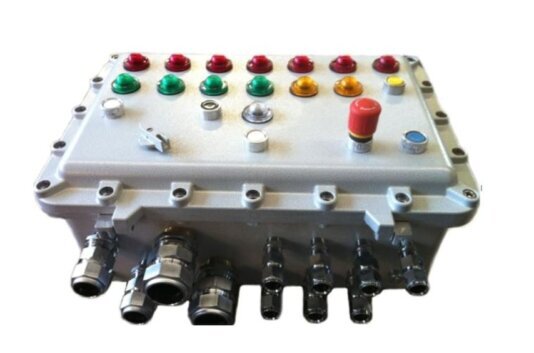
The “boxes” EExd can be pressurized with: clean air or inert gas, shall be designed with various controls to cut power, and provide notification in case of gas supply or pressure loss. The pressurized box has a tough body, resembling a double turtle shell, with gas-tight penetrations. The shells are secured together by screws that require a special tool to remove.
Pressurized box
Electrical equipment
Electrical equipment shall be installed in hazardous areas only when it is unavoidable for operational reasons. The explosion protection of the installed and operated electrical equipment shall meet the characteristics of the dangerous cargo.Pendant Light Fitting
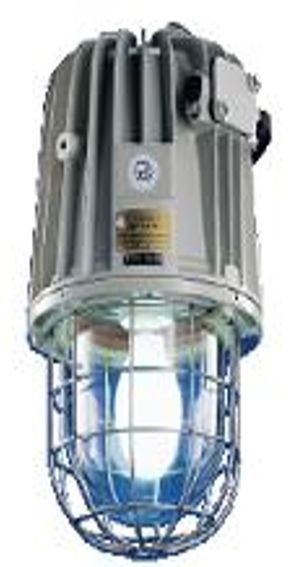
Pendant light suitable for use in Zone 1, Fitted with glass dome. Explosion protection: EEx de IIC T4 (250W) / EEx de IIC T3 (400W), Ingress protection: IP65.